Hello Retriever for Distributed Teams: A Reality Check.
A detailed review of Hello Retriever's pricing, features, limitations, and how it compares to full lifecycle management platforms.
 Ahmad ZakariaMay 26, 2026
For People Ops leads and lean IT managers at remote companies with 50 to 400 employees, offboarding is rarely the problem.
Recovering the hardware is.
A laptop doesn't come back, the charger is missing, shipping labels get buried, IT follows up, HR escalates, Finance writes off the asset — what looked minor becomes recurring operational drag.
When a device is not recovered, the impact goes beyond replacement cost. The average cost of a lost laptop can exceed $49,000 when data exposure and response costs are included. Retrieval carries financial and security risk.
Hello Retriever is purpose-built to solve that narrow but expensive problem. The platform focuses on laptop recovery for distributed teams. It handles prepaid boxes, shipping coordination, automated communication, and tracking, so internal teams do not manually chase employees.
For companies operating within a single country and managing moderate exit volume, that focus works well.
But as your team scales, the operational demands move past retrieval into procurement, inventory visibility, cross-border logistics, and standardized lifecycle control.
That shift changes how Hello Retriever should be evaluated. This article evaluates Hello Retriever through one key question: Does your operation simply need a device return workflow, or a complete lifecycle management platform?
Hello Retriever Explained
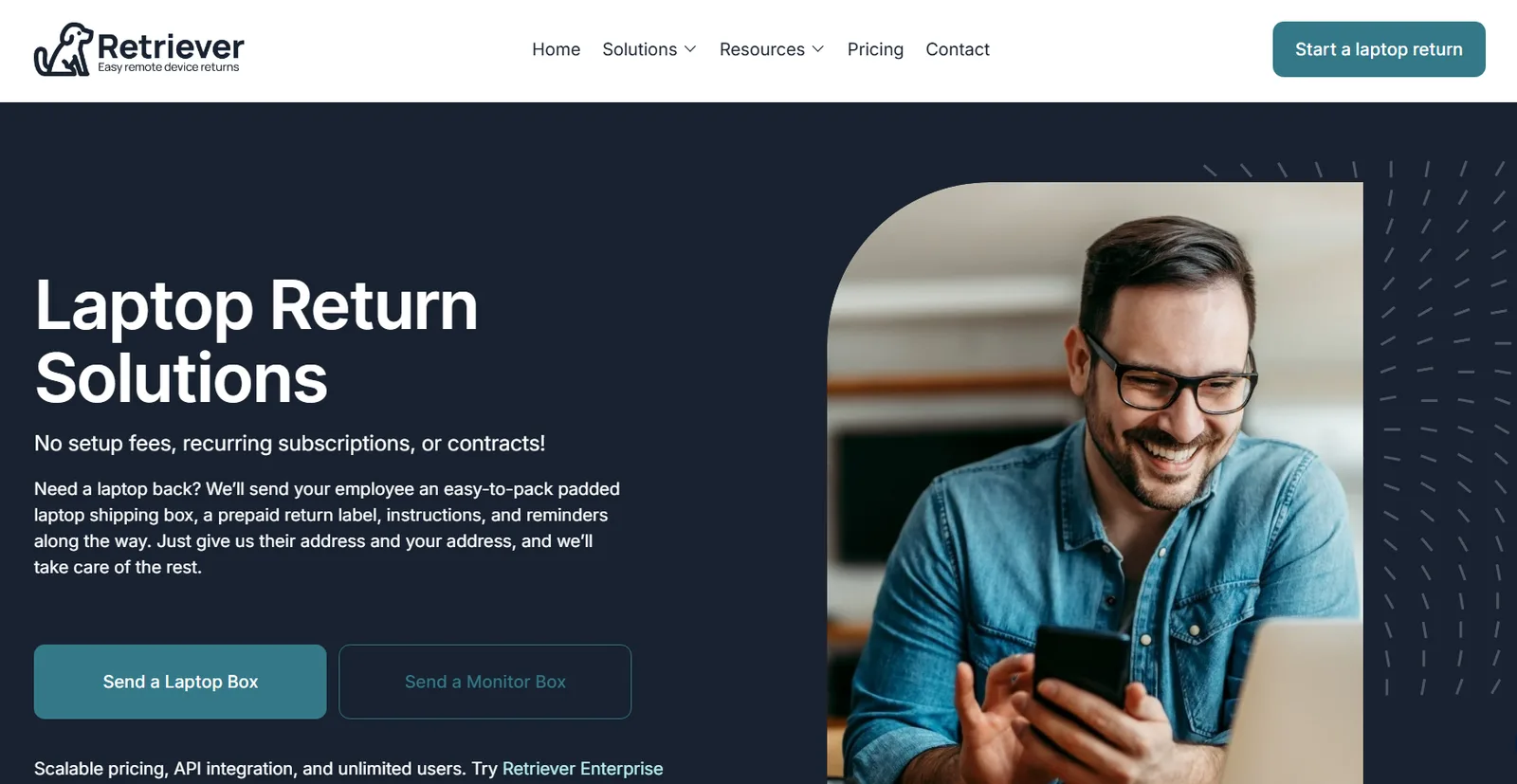
Hello Retriever is a device recovery service designed to help companies recover corporate laptops when employees leave. It's mainly for distributed teams with remote employees that do not want to manage return logistics manually.
The platform is intentionally scoped around hardware (laptop, monitor, mobile, and charger). It manages the return workflow end-to-end, from sending prepaid kits to tracking the device back to your team.
Here's how it works at a core level:
| Feature | What Hello Retriever Provides |
|---|---|
| Prepaid return box | Ships a recovery kit directly to the departing employee |
| Shipping label | Prepaid and pre-configured for easy drop-off |
| Employee communication | Automated email outreach and reminders (for delayed returns) |
| Tracking | Real-time visibility into return status |
| Starting price | $95 per recovery |
| Primary geographic coverage | United States, Canada, United Kingdom |
Hello Retriever Features: What You Actually Get
Hello Retriever's value is in removing manual coordination from the laptop/monitor return process. Across real deployments, teams have experienced reduced admin work and more predictable return outcomes.
Below is a breakdown of core capabilities and how they compare in operational terms.
Shipping kit quality: Hello Retriever sends a laptop shipping box with a ready-to-use prepaid return label. This minimizes friction for the departing employee and reduces mistakes that cause delays.

Enterprise retriever portal and visibility: Users often highlight the centralized dashboard.

Operationally, this means:
- Return status is visible in one place
- HR teams and management can be granted access
- IT does not need to provide manual updates
For distributed teams, visibility reduces the risk of "silent loss" where devices go untracked after offboarding.
Responsive, real-time support: Retriever differentiates itself through hands-on support. Reviewers frequently mention same-day responses, shared Slack channels, and proactive coordination during emergencies.

This shows that Retriever often operates as an active logistics partner, more than a transactional return service.
Fast setup and low barrier to entry: Several users mention quick onboarding.

This aligns with Retriever's lightweight implementation model — no complex integration required, no infrastructure deployment, and quick activation.
Part of that speed comes from how quickly retrieval kits get shipped. Once you initiate a return, Retriever ships the kit to your employee within one business day, and it typically arrives at their address in 2–3 days. After they send the laptop back, it usually takes another 2–3 days for the device to get to your company address.
Responsive operational support (beyond standard recovery): While Hello Retriever positions itself as a device recovery service, customer reviews indicate that the offering also covers hardware coordination and replacement logistics when needed.

Apart from the standard laptop retrieval process, Hello Retriever includes the following services for certain customers:
- Secure warehousing: Returned laptops can be stored in secure facilities until they're needed again.
- Deployment on demand: Teams can trigger deployments from the portal, sending ready-to-use devices directly to employees.
- Secure disposal and data destruction: At the end of life, laptops can be wiped and disposed of in compliance with industry standards.
Where the Workflow Stops
Hello Retriever has structured laptop retrieval as its core function. But it stops where its scope ends. For mid-market IT leaders, missing capabilities become material as volume grows or workflows become more complex.
- Limited device scope: Hello Retriever mainly supports laptops and monitors (with chargers) and cell phones. It does not cover peripherals, furniture, or broader non-IT equipment without custom arrangements.
- Geographic constraints: Retriever supports the U.S., Canada, and the U.K. as standard. Broader global coverage is available only through custom arrangements.
- Not a full lifecycle platform: Retriever focuses on return coordination, warehousing, and redeployment. It does not provide procurement workflows, automated refresh cycles, or lifecycle analytics.
- Pay-per-return pricing: At $95 per laptop return, the model works well for occasional offboarding. At higher volumes, costs may exceed subscription-based lifecycle platforms.
- API-based integrations: Retriever offers a REST API for HRIS and ITAM automation. However, integrations are not native or turnkey.
- No native MDM integration: Tracking is shipment-based rather than endpoint-based. Remote wipe, geolocation, policy enforcement, and compliance monitoring require a separate MDM solution.
SEE IT IN ACTION
Take a self-guided tour of Firstbase
See how Firstbase centralizes procurement, deployment, tracking, retrieval, and redeployment into one global platform — replacing point solutions like retrieval-only tools.
Take the Tour →Hello Retriever Pricing: What It Costs at Scale
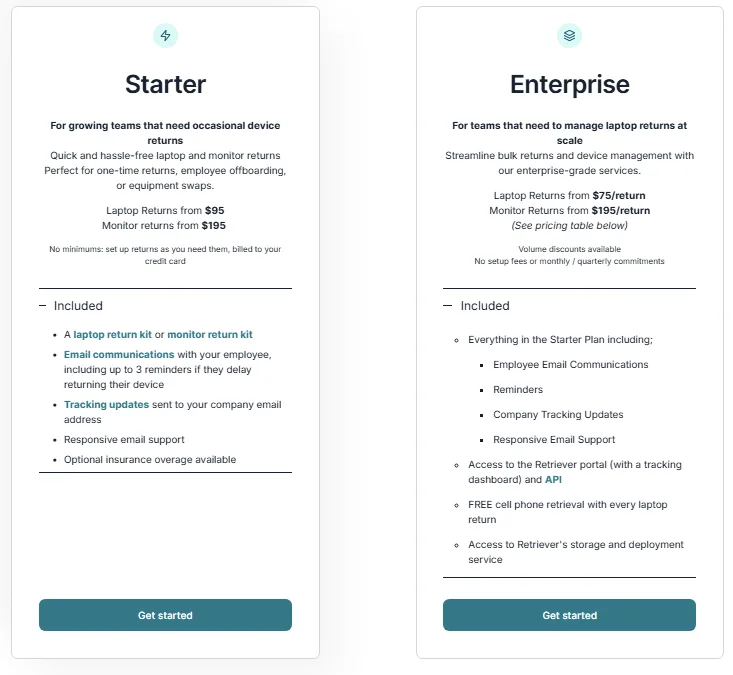
Retriever has 2 pricing options:
- Starter (pay-as-you-go): Laptop returns from $95 per return; monitor returns from $195. No minimums, and you pay per transaction.
- Enterprise (prepaid batches/volume pricing): Enterprise customers prepay a batch of returns (minimum 10 credits). Enterprise laptop returns at $75/return and $195 for monitor returns, with discounts at higher volumes. You also get a free mobile phone retrieval for every laptop return.
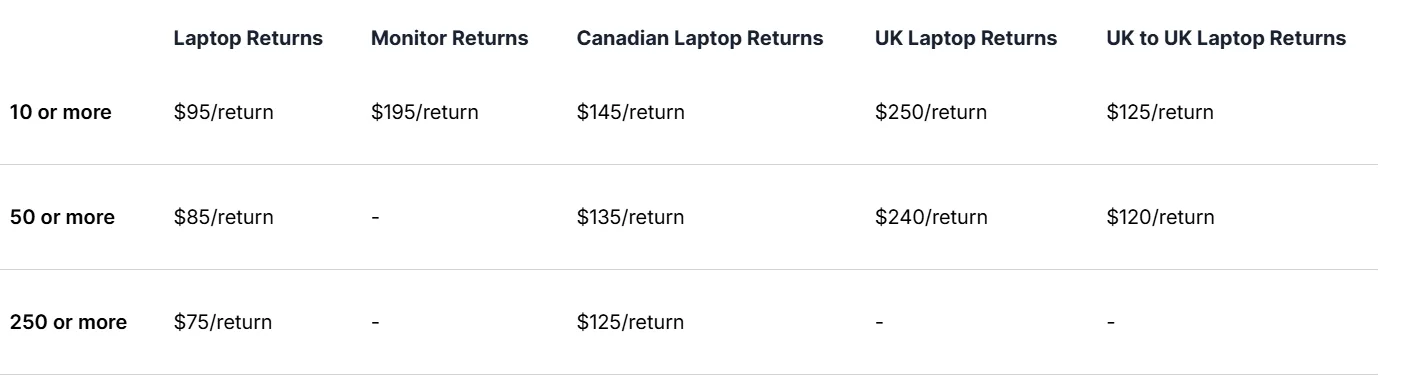
For 10–250+ returns, here is what you pay across regions:
Are there any additional charges beyond the base price?
In addition to the base return price, there are a few optional add-ons to factor in:
- If you need to include a mobile phone in the same return shipment, Hello Retriever charges an additional $9 per returned phone. This fee is waived under the Enterprise plan.
- For higher-value devices, you can purchase supplemental shipping insurance at $10 per $1,000 of additional coverage.
Let's model the math if you have 10 offboardings a month (120 per year):
Scenario A: Base only
| Item | Unit Cost | Count | Total |
|---|---|---|---|
| Laptop returns | $95 | 120 | $11,400 |
Scenario B: Add cell phone return for half
| Item | Unit Cost | Count | Total |
|---|---|---|---|
| Laptop returns | $95 | 120 | $11,400 |
| Cell phone add-on | $9 | 60 | $540 |
| Total | $11,940 |
Scenario C: Add moderate insurance ($1,000/device x 120)
| Item | Unit Cost | Count | Total |
|---|---|---|---|
| Laptop returns | $95 | 120 | $11,400 |
| Insurance (+$10 per $1,000) | $10 | 120 | $1,200 |
| Total | $12,600 |
Individually, these add-ons are minor. At higher volumes, however, they can increase annual spend, depending on how frequently they're used.
Pay-per-return pricing is predictable. Total lifecycle cost often isn't.
Use Firstbase's ROI calculator to estimate how much your team could save by centralizing procurement, deployment, and recovery into one global workflow.
Buyer essentials: Key questions answered
1. Do you have any monthly or yearly minimums?
The Starter plan has no minimums. The Enterprise plan requires a minimum purchase of 10 prepaid return credits, but no recurring commitments.
2. What happens when my team runs out of prepaid returns?
Credits do not expire. If you run out of prepaid credits, you purchase additional prepaid credits to continue processing returns. You can also track the remaining balance through the dashboard.
3. Are shipping costs included in the base price?
Yes, Hello Retriever's base return price typically includes standard shipping for the return kit and domestic transit within supported regions.
4. Are volume discounts available?
Yes. Under the Enterprise plan, per-return pricing decreases at higher prepaid volume tiers. Discounts depend on the number of return credits purchased.
When Retriever Works and When You've Outgrown It
Retriever operates as a reverse-logistics layer. It manages return kits, prepaid return labels, courier tracking, warehousing, and certified data destruction. That's useful when device recovery is an occasional administrative task and not a recurring operational function.
However, once device movement becomes frequent, international, or compliance-sensitive, retrieval alone is no longer sufficient.
The Volume Threshold: When Pay-Per-Return Becomes Structural Cost
Retriever charges $95 per laptop return. At low volumes, that's reasonable. But at high volume requirements:
- 10 offboardings/year → $950
- 25 offboardings/year → $2,375
- 50 offboardings/year → $4,750
This does not include internal IT coordination time, follow-ups with employees, cross-border shipping complexity, or devices that sit idle in storage.
Once offboardings exceed 20 per year, retrieval becomes an operational workflow, not an exception. At that point, lifecycle platforms that bundle procurement, provisioning, redeployment, and recovery into one system often reduce total operational overhead.
Geographic Reality: Where Logistics Becomes Fragile
Retriever's standard coverage focuses on the US, UK, and Canada. Broader international support requires custom coordination.
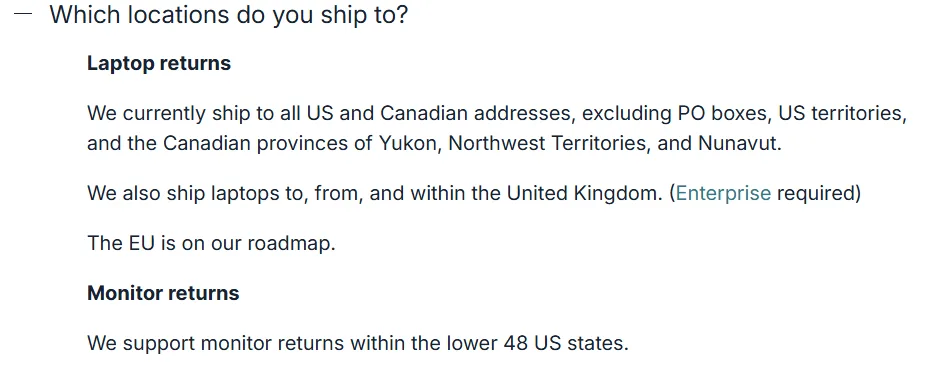
This is manageable when most employees sit in supported regions and international hires are rare. It becomes unpredictable when you hire, onboard employees, or expand into non-primary markets.
Lifecycle infrastructure platforms solve this by operating in-country hubs with predefined workflows rather than ad hoc arrangements.
The Gap Between Audit Proof and Governance
Retriever provides NIST 800-88 and DoD-standard data destruction, Certificates of Data Destruction, and SOC 2 Type 2 compliance. That ensures secure disposal.
What it does not provide is complete visibility into the continuous lifecycle:
- No live asset state analytics
- No automated refresh forecasting
- No integration with MDM-triggered lock/wipe workflows
- No compliance-state dashboard across regions
For early-stage or low-risk teams, disposal certification is enough. But for companies undergoing SOC 2 audits or managing GDPR exposure across borders, lifecycle traceability is often more important than end-of-life documentation alone.
Retrieval Layer vs Lifecycle Infrastructure
| Criteria | Retriever | Lifecycle Platform |
|---|---|---|
| Core Focus | Device return logistics only | End-to-end device lifecycle |
| Pricing Model | Pay per return | Subscription-based |
| International Scaling | Limited/custom | Built-in global coverage |
| Redeployment Automation | Manual coordination | Automated workflow |
| MDM Alignment | Not native | Integrated lifecycle sync |
| Procurement | Not included | Included |
| Refresh Planning | Not included | Automated forecasting |
Why Every Hello Retriever Evaluation Leads to the Same Answer: Firstbase
Hello Retriever solves one part of the device lifecycle: retrieving hardware. That's necessary for small, domestic teams with occasional offboarding needs. In its domain, it works.
But when you apply this to an organization with more than 5,000 employees, it should cover everything from procurement to cost optimization, since the market has already moved beyond retrieval alone. That movement is measurable.
Firstbase fills that gap through its full device lifecycle management model. Instead of handling only returns, it centralizes procurement, deployment, tracking, retrieval, redeployment, and refresh planning inside one global infrastructure.
Hello Retriever does one thing well: it gets the box back.
For teams where that's the whole problem, it's a clean solution. For teams where the device also needs to be wiped, stored, redeployed, or tracked across borders — the return is just the beginning.
Firstbase customers recover 50%+ more devices at offboarding and eliminate per-return manual coordination entirely.
Frequently Asked Questions
What is the alternative to Hello Retriever?
A practical alternative to Hello Retriever is a full device lifecycle management platform like Firstbase. While Retriever focuses on return logistics, lifecycle platforms manage procurement, deployment, tracking, retrieval, redeployment, and refresh planning in a single system.
Is the Retriever suitable for international teams?
Hello Retriever mainly supports returns in the United States, the United Kingdom, and Canada. Coverage outside these regions typically requires custom arrangements. For companies hiring across Europe, APAC, or LATAM, this may create logistical variability.
Does Retriever integrate with MDM?
No, Hello Retriever does not offer native MDM integration. It manages shipment tracking and return workflows but does not provide endpoint-level controls such as remote wipe confirmation, geolocation tracking, or compliance monitoring.
How does Retriever compare to a full IT asset management platform?
Hello Retriever focuses on reverse logistics, including return kits and certified data destruction. A full IT asset management platform also covers procurement, provisioning, real-time asset tracking, redeployment automation, and refresh planning.
How much does Retriever cost for enterprise teams?
Hello Retriever offers pay-per-return and prepaid enterprise pricing. Starter rates begin at $95 per laptop return and $195 per monitor return. Enterprise plans start at $75/return for a laptop and $195/return for monitors.
Written by
Ahmad Zakaria
Ahmad Zakaria covers IT operations, hardware lifecycle management, and distributed workforce solutions at Firstbase. His content is built from real customer data, operator interviews, and hands-on experience managing devices across 150+ countries.
Get started with
Firstbase today
Remote and hybrid work aren't going anywhere. It's our mission to make it easier to manage the assets your distributed team needs—from onboarding through offboarding and every repair, replacement, and upgrade in between.
Fill out the form and a member from our team will reach out by phone!
Get a Live Demo